Safeguarding and Welfare Requirements
Safeguarding: What's New
Benedict's Law: Allergy Safety in School - Statutory Guidance
As Benedict’s Law is now in place, here's an update on what is available around guidance and training Allergy safety in schools - GOV.UK.
From September 2026, schools are required to have whole school allergy awareness training.
Paediatric First Aid does cover allergic reactions, anaphylaxis, and the administration of adrenaline auto-injectors, such as EpiPen devices. However, it is not sufficient on its own to meet the requirements associated with Benedict’s Law. The new guidance specifically states that first aid training alone is not sufficient.
The requirement is broader than training designated first aiders. Schools are expected to arrange whole-school allergy awareness and emergency-response training at least annually for all staff who are present when pupils are on site. This includes permanent and temporary staff, supply and peripatetic staff, agency workers, regular volunteers, catering staff, and staff supervising breakfast or after-school clubs.
The training should ensure that staff:
- Understand allergies and the risks they present
- Recognise the symptoms of an allergic reaction and anaphylaxis
- Know how to respond in an emergency, including calling 999 and informing parents
- Know how to locate and administer prescribed or spare adrenaline devices
- Have training in using the relevant devices
- Understand the school’s allergy safety policy
- Know how to access and follow Allergy or Asthma Action Plans
- Understand how to reduce the risk of exposure to known allergens
- Know how to report allergic reactions, serious incidents and near misses
Training (all staff) is only one part of the wider requirements. Schools will also need to:
- Have a dedicated, published allergy safety policy (template here)
- Identify a named senior lead
- Ensure appropriate Individual Healthcare Plans and Allergy Action Plans are in place (template here)
- Make suitable arrangements for prescribed and spare adrenaline devices
- Record and learn from serious incidents and near misses
In relation to training, Bolton Council offer:
- Paediatric First Aid Training: booking via Bolton Under Fives Forum (BUFF) boltonunder5@tiscali.co.uk
- A digital Food Allergy Awareness Course is available for all council staff via Me-Learning, staff just need to log on and find the course, enrol, and launch the course.
Non council staff can access this course, however there is a course/licence fee of £30 per person (the licence gives access to over 200 digital courses covering many subjects including Food Allergy Awareness).
Some settings and schools have already purchased Me-Learning licences, and the updated course is already in their library.
For more information around Me-Learning in general and what courses are available contact amy.taylor9@bolton.gov.uk
or to purchase a Me-Learning licence, send the following information to learninganddevelopment@bolton.gov.uk
- Full name
- Valid email address
- Name of organisation
- Address of organisation for billing purposes
In addition, there is a free course 'Allergy and Anaphylaxis Training for Schools' currently available that provides an awareness of what Benedict’s Law is. You can access more information about this here: Free Allergy Training For Schools | City & Guilds Assured.
Bolton Safeguarding Children Partnership (BSCP) Call to Action
Bolton Safeguarding Children Partnership (BSCP) has issued a Call to Action to strengthen Bolton's collective response to child neglect.
Despite progress, neglect remains a significant concern, and further improvement is needed to ensure children experience real and sustained change.
Over the next six months, all organisations are expected to prioritise neglect and demonstrate measurable impact.
A Framework for Managers, Leaders and Practitioners
The Call to Action - Tackling Child Neglect in Bolton (June 2026) document provides a framework to help leaders, managers, and practitioners reflect on practice and drive improvement.
Key expectations include:
- Earlier identification of neglect and cumulative harm.
- Stronger multi-agency working and information sharing.
- Consistent use of tools and professional curiosity.
- A clear focus on the child’s lived experience.
- Timely challenge to drift and delay.
Please ensure it is shared widely and used within your organisation.
BSCP will review progress and seek assurance on impact in six months.
Further resources are available via the BSCP website: https://www.boltonsafeguardingchildren.org.uk/child-neglect
Every interaction matters. Every practitioners has a role. Every child deserves better.
New Safeguarding Guidance
The Department for Education (DfE) has published new safeguarding guidance for early years providers to help practitioners, managers, and childminders understand and apply the safeguarding and welfare requirements of the EYFS.
The new content provides practical information and advice on creating a strong safeguarding culture, recognising concerns early, responding appropriately, and ensuring children are safe, healthy and supported to thrive.
The guidance includes information on:
- the safeguarding responsibilities of early years providers and practitioners
- the role of the Designated Safeguarding Lead (DSL)
- creating and maintaining a strong safeguarding culture
- recognising signs of possible abuse, neglect and harm
- raising, recording and reporting safeguarding concerns
- whistleblowing procedures and when to use them
- safer recruitment and vetting requirements
- working in partnership with parents and carers to keep children safe
- staff training, supervision and ongoing safeguarding practice
- attendance, absence monitoring and information sharing
- resources, posters and links to further guidance and support
By using this guidance and supporting resources, you can strengthen safeguarding practice in your setting, support staff confidence and help ensure every child grows up in a safe, nurturing, and protective environment.
Updated EYFS Frameworks Come into Force 1 September 2026
The main changes to the updated EYFS Frameworks for childminders and group and school-based providers are outlined below and *represent strengthened safeguarding requirements.
Both EYFS frameworks include updates which:
- Bring explicit wording on the safer sleep requirements into the main body of the EYFS, so that providers do not need to refer out to separate guidance.
- Prohibit the provision of registered childcare from any premises where a banned dog breed is kept or is otherwise present.
- Require providers to inform Ofsted or their childminder agency (CMA) of allegations of ‘harm’ (instead of ‘serious harm’) by anyone living, working, or looking after children at the premises.
- Require enhanced criminal records checks for volunteers (including those who are supervised) and prevent new employees from commencing employment before receiving their check.
- Amend the requirements for what providers must tell staff they have to disclose, as part of information that may affect their suitability to work with children.
- The group and school-based version also requires providers of childcare on domestic premises to notify Ofsted or their CMA of changes to persons aged 16 or over living or working at the premises. This aligns with existing requirements for childminders.
*Other minor clarificatory changes have been made to both frameworks.
Changes to registration requirements - in relation to banned dog breeds
In addition to the changes to the EYFS frameworks outlined above, the department has also updated registration requirements for early years settings as follows:
- Nannies will be prohibited from taking a banned dog breed onto a premises where they are providing childcare, and will be required to take reasonable steps to avoid banned dog breeds being present.
- All other voluntarily registered, Early Years and Later Years providers will be prohibited from providing registered childcare from any premises where a banned dog breed is kept or present.
Controlling your dog in public: Banned dogs - GOV.UK
Ofsted Update: Banned Dog Breeds and Domestic Childcare
Ofsted has confirmed its position regarding banned dog breeds in domestic childcare settings. Ofsted do not believe that banned breeds are compatible with childcare. This means any dog classified as a banned breed must be kept in an entirely separate area with no access to any space used by children when childcare takes place. Please be advised, Ofsted has worked with the Department for Education and the Department for the Environment, Food and Rural Affairs to reach this decision.
Please refer to the updated registration guidance. This impacts childminders and childcare on domestic premises providers.
If Ofsted become aware that an existing provider has a banned breed of dog on the premises, they may need to take action to remove the risk to children. Providers already registered to provide childcare from a domestic premises where a banned breed of dog resides should contact Ofsted.
Inspectors will discuss the possible options available to providers and applicants as part of their work.
If you have any questions, please contact EYRegulatoryandSocialCare@ofsted.gov.uk
Create and Maintain Safer Sleep Environments for Babies and Young Children
The DfE has published new guidance for early years providers: Help for early years providers : Safer sleep
The guidance has been developed in collaboration with The Lullaby Trust and supports planned updates to the Early Years Foundation Stage (EYFS) statutory framework, expected to come into effect from September 2026.
It includes information on:
- how to provide an appropriate sleep space for babies and children
- safe use of cots, mattresses, bedding and sleep bags, including relevant British Standards
- how to supervise children while they are sleeping
- what to do when babies and children fall asleep while travelling,
- managing temperature, positioning and the use of comforters
By following this guidance, you can help keep children safe and meet EYFS requirements, while supporting consistent practice across early years settings.
Further information is available through NHS guidance on sudden infant death syndrome and from The Lullaby Trust.
Until the guidance above comes into effect, please continue to follow the EYFS statutory framework on sleeping arrangements (section 3.84). The EYFS statutory framework will be updated in time for September, in line with the above new DfE guidance.
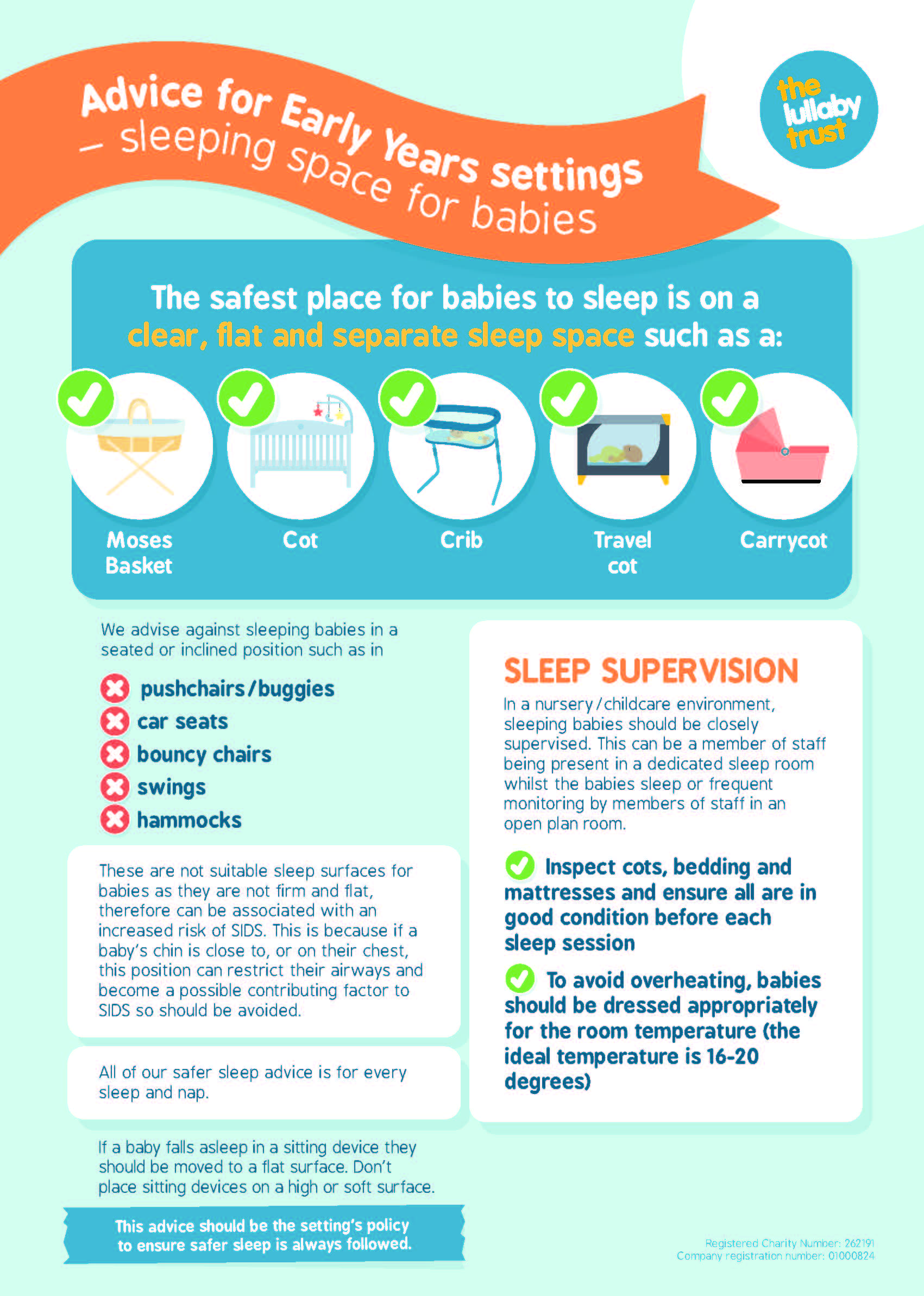
The Lullaby Trust poster for childcare providers
A handy poster with advice on what babies should sleep in in early years settings. Poster for Childcare Providers
Centre of Expertise on Sexual Abuse: New Guidance and Webinar
The Centre of Expertise on Sexual Abuse has published a new step by step guide for early years provision to help improve the response to child sexual abuse.
For more information visit: New Publication: Centre of Expertise on Sexual Abuse – Bolton Start Well
Useful information
Early Years Foundation Stage (EYFS) safeguarding reforms: Summary of changes